
New York City requires pedestrian protection when construction activity creates hazards beside public walkways. Sidewalk sheds, fences, scaffolding, and temporary barriers serve an important safety purpose, yet they can hide restaurant entrances, awnings, windows, and menus. A familiar storefront may suddenly look closed, while an unfamiliar one can disappear from view entirely.
For restaurant owners, the practical challenge is maintaining a visible route without competing with required safety messages. Well-planned construction signs NYC can help distinguish an operating business from the work surrounding it. Directional boards, entrance markers, and carefully placed A-frames give pedestrians quick guidance when the normal visual path to a dining room has been interrupted.
Why Construction Changes the Way Diners Read a Block
People walking toward a restaurant usually rely on several clues at once: the storefront, door, menu display, outdoor seating, and movement of other customers. Construction removes or weakens those clues. Solid fencing blocks sightlines, overhead sheds darken the walkway, and equipment creates visual noise that makes smaller business messages harder to notice.
Safety information naturally takes priority. The New York City Department of Buildings states that sidewalk sheds must display permits and identifying details, including permit numbers, expiration dates, and contact information for the permit holder. These official panels tell pedestrians that the structure is regulated, although they do not necessarily explain whether businesses behind it remain open.
Longer street projects create another layer of information. The New York City Department of Transportation requires informational signs for certain permitted projects lasting at least three months. Those signs must appear near the beginning and end of the work area, remain readable, and be kept in good condition. Diners may therefore encounter project descriptions, detour notices, parking restrictions, and restaurant messages within a short distance.
Wayfinding as the Practical Bridge
A useful restaurant sign answers three questions quickly: Is the business open? Where is the entrance? Can the pedestrian reach it safely? Once those points are clear, details such as cuisine, hours, reservations, or takeout service can follow. This order reflects how people make decisions while moving through a constrained walkway.
Arrows are especially valuable when a barrier shifts the entrance away from its expected location. The Federal Highway Administration includes pedestrian detour signs in its Manual on Uniform Traffic Control Devices and calls for clear directional guidance when normal pedestrian flow is rerouted. Although restaurant boards are different from official traffic-control devices, the same principle applies: guidance should appear before the point where someone must choose a direction.
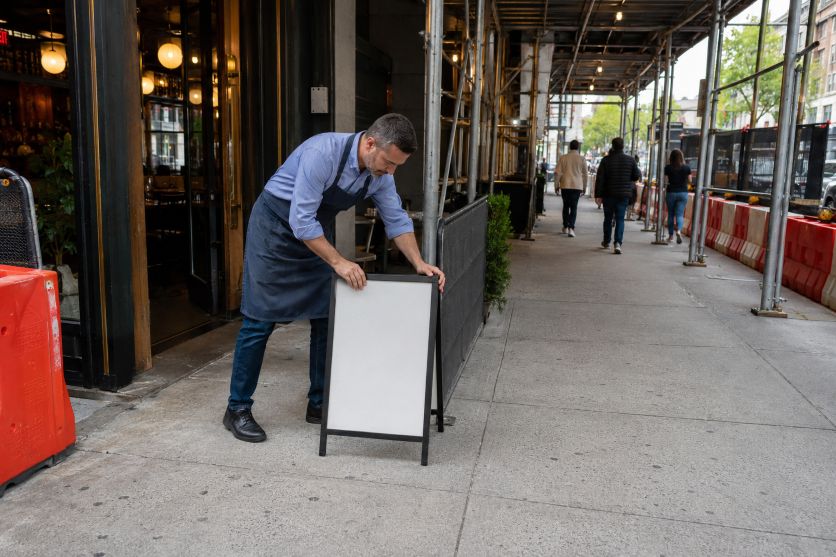
An A-frame can provide that early cue because it sits closer to a pedestrian’s natural line of sight than a sign hidden above scaffolding. Its strongest message is usually brief, such as “Entrance Ahead” or “Open During Construction,” accompanied by one clear arrow. Too many menu items, decorative elements, or competing type styles can delay understanding.
Placement Matters as Much as Wording
Portable signs must preserve the walkway rather than create another obstacle. Guidance from the New York City Department of Sanitation says sidewalk signs and displays cannot extend more than three feet from a building or rise above five feet. The agency also notes that construction sites must maintain at least five feet of pedestrian space on the sidewalk or within a protected street pathway.
That means placement should be coordinated with the property owner, construction permit holder, or site supervisor. A board positioned beside a narrow passage, curb ramp, bus stop, or construction gate may confuse pedestrians or restrict access. Restaurant operators should also confirm applicable city rules before putting any portable display within the public right of way.
Lighting deserves similar attention. Reports from the New York City Department of Buildings explain that sidewalk-shed applications filed on or after August 15, 2025, are subject to increased lighting requirements intended to brighten covered walkways. Even under improved lighting, restaurant information needs adequate contrast and lettering that remains legible from the approach direction.
How to Read the Signs on a Construction Block
Diners can separate messages by purpose. Official panels identify the project and responsible parties. Regulatory signs mark closures, hazards, or approved detours. Business wayfinding indicates whether a restaurant is operating and where customers should enter. Treating these as different layers makes a crowded streetscape easier to understand.
- Look for an arrow that agrees with the protected pedestrian route.
- Check whether the entrance shown is visible, lit, and unobstructed.
- Give official closure and detour instructions priority over advertising.
- Do not step around barricades because a restaurant board appears to point through them.
- For unclear or damaged official signs, use NYC311 to report the location.
Restaurant owners can review the same block from a customer’s perspective, beginning at both corners and walking toward the entrance. A message that works beside the door may be invisible from twenty metres away. Because food and comfort shape customer experiences, clear wayfinding can help the sense of welcome begin before diners enter. Repeating a concise directional cue at a lawful decision point may be more helpful than enlarging a menu display.
A Clearer Street-Level Conversation
Construction signage forms a quiet conversation between the city, contractors, businesses, and pedestrians. Safety panels explain the work, detour markers control movement, and restaurant boards restore information lost behind barriers. When these messages are accurate, readable, and properly placed, diners can navigate confidently without treating an active work zone as an invitation to take shortcuts.
The most effective block is not the one with the greatest number of signs. It is the one where each sign has a distinct job. Diners should look for safe, consistent directions, while owners should check visibility from the approach, coordinate placement, and keep temporary information current as the site changes.
